
Offenbach, 02.April 2026
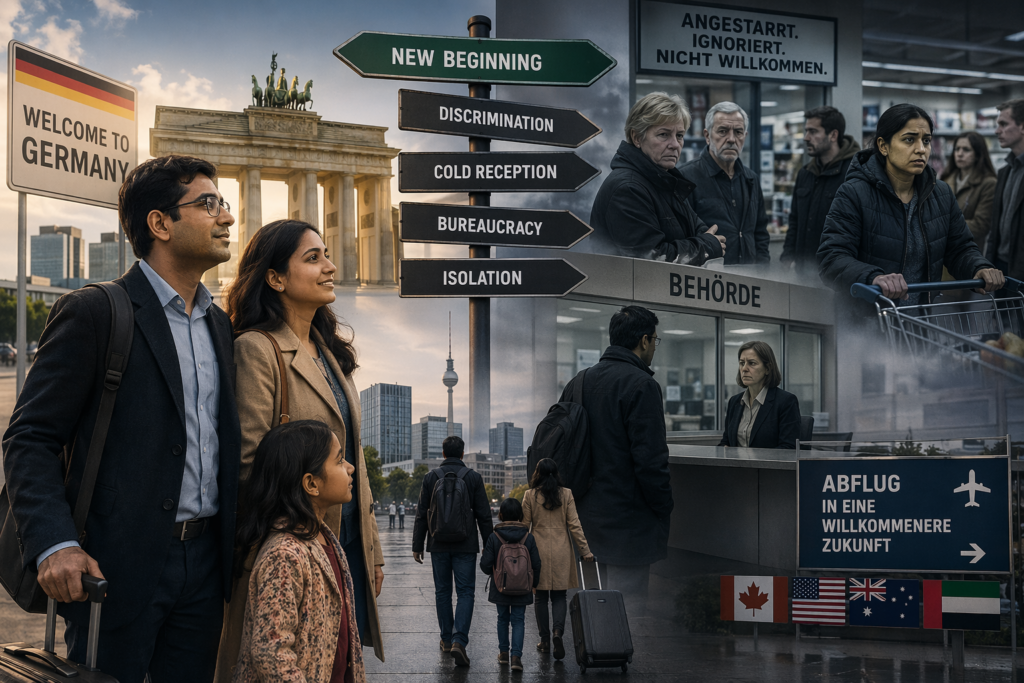
Germany has been trying since 2000 to attract Indian skilled workers, especially in IT and other highly qualified sectors. This was not only a recent development. As early as 2000, Germany launched its IT Green Card programme for foreign specialists, and India was one of the main countries relevant to that effort in practice. Later came broader instruments such as the EU Blue Card, the Skilled Immigration Act, and finally the migration partnership with India. Over time, German policy clearly became more open and more systematic.
But the central problem was never only the law. Germany could open visa routes, yet still fail to remain attractive in everyday life. That is one of the key historical truths of this topic. Research on Indian high-skilled migrants in Germany found that their migration experience was often complicated by a felt distance to the local population, experiences of discrimination, and difficulties with German bureaucracy. Those are not minor details. They directly affect whether people decide to stay, bring their families, or leave again.
This matters because skilled migration is never only about the worker. A software engineer may have a job contract, but the family has to live in German society every day. They go to supermarkets, schools, doctors, public offices, shops, and transport systems. If, in those daily situations, they feel stared at, treated as outsiders, or met with cold and unfriendly behaviour, then the country loses attractiveness no matter how good the formal visa rules may be. That is why some Indian professionals and their families concluded that Germany was professionally useful, but socially exhausting.
This is not just anecdotal. It has also been reported in the press. Reuters reported in 2024 that xenophobia and racial tensions were costing German companies skilled foreign labour, with some workers leaving because of discrimination and hostility. Reuters also reported, citing OECD findings, that migrants in Germany experience racism and discrimination in everyday life, even though Germany remains economically attractive to many. So the issue is real: Germany’s difficulty was not only attracting foreign talent, but convincing them and their families that everyday life in Germany was worth building a future around.
That is why the history of German policy toward Indian professionals since 2000 must be described honestly. The Green Card, the Blue Card, later skilled-migration reforms, and the India mobility partnership all show that Germany wanted foreign talent. But for many years, the country often offered a contradiction: legal openness on paper, yet too much social distance in practice. Bureaucracy, language dependence, recognition problems, and an often unwelcoming everyday environment weakened the long-term success of these policies.
So the real lesson is this: Germany did not fail because it made no effort. Germany failed repeatedly because effort at the level of law was not matched strongly enough by ease, warmth, and openness in lived reality. A country does not become attractive simply because it creates a visa. It becomes attractive when skilled migrants and their families can live there without feeling constantly foreign, socially exposed, or structurally disadvantaged. That was too often not the case.
Below links were accessed on the date this article was written:
https://www.bpb.de/themen/migration-integration/kurzdossiers/58174/the-german-green-card/?utm
https://www.swissinfo.ch/eng/racial-tensions-cost-germany-inc.-skilled-foreign-labour/74401428
https://www.bpb.de/themen/migration-integration/kurzdossiers/58174/the-german-green-card/?utm