
From the Green Card to the Blue Card and beyond, Germany created legal pathways for Indian skilled workers. But a democracy is not judged only by access on paper. It is judged by whether people can live with dignity, fairness, and effective protection in everyday life.
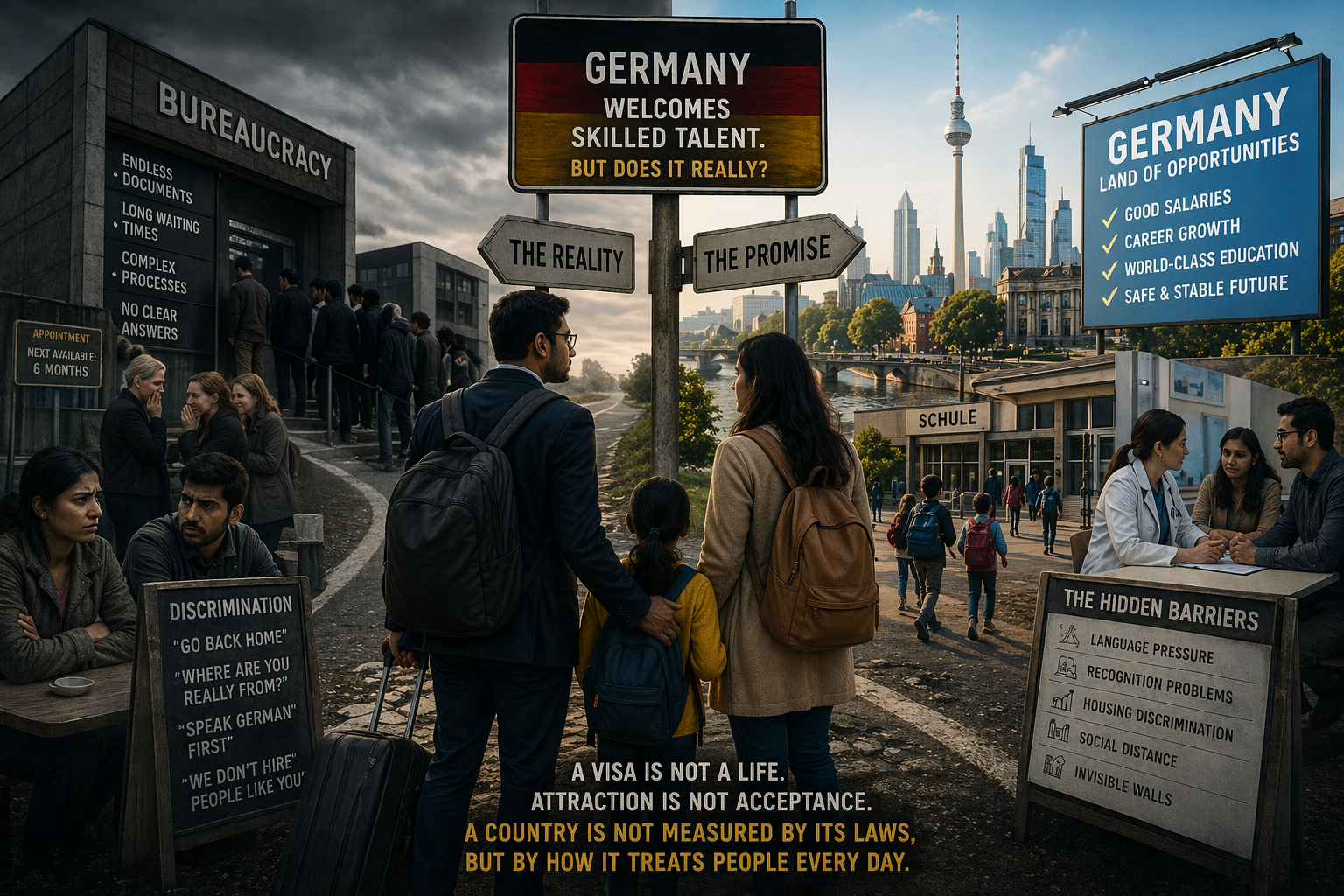
Germany has been trying for a quarter of a century to attract Indian skilled workers. This did not begin with the current debate, nor with the latest partnership agreements. It began in political terms as early as 2000 with the IT Green Card, continued with the EU Blue Card, was expanded through the Skilled Immigration Act, and was later reinforced through the migration and mobility partnership with India. In legal terms, Germany became more open over time. That much is true. But that is only half the story.
The other half is less flattering. Germany repeatedly improved access on paper while failing to make everyday life reliably livable, dignified, and welcoming in practice. This is exactly where the deeper problem lies. The question was never only whether Indian professionals could obtain a visa. The real question was whether they and their families could live in Germany without being worn down by bureaucracy, social distance, and the daily experience of being treated as if they did not quite belong. Research on Indian high-skilled migrants in Germany explicitly points to felt distance from the local population, experiences of discrimination, and difficulties with German bureaucracy as factors shaping the migration experience.
That matters because migration is not an abstract labour-market transaction. A software engineer may receive a contract, but the family must face Germany as it actually is: in supermarkets, schools, doctors’ offices, public authorities, shops, housing markets, and public transport. If daily life is marked by coldness, stares, dismissiveness, bureaucratic obstruction, or subtle exclusion, then the country’s formal openness loses much of its value. A state cannot seriously claim success in attracting skilled people if their spouses and children experience ordinary life as socially exhausting. In that sense, Germany’s problem was never merely migration law. It was the gap between legal invitation and lived reality. This gap also resonates with the project goal of de21jh.de, which argues that rights must not remain formal promises but must become effective, accessible, and enforceable in everyday life, especially where individuals face structural disadvantage.
This is not just anecdotal criticism. It has also been visible in public reporting and broader migration research. Reuters reported in 2024 that xenophobia and racial tensions were costing Germany skilled foreign labour, with workers leaving because of discrimination and hostility. A recent IAB research report likewise found that almost two thirds of migrants report perceived discrimination in at least one area of life in Germany and stressed the importance of an open-minded social climate for long-term ties.
That is why the history of German policy toward Indian professionals since 2000 must be described more honestly than it usually is. Germany did not fail because it made no effort. It failed because legal effort was too often disconnected from the individual reality people encountered after arrival. It created programmes, permits, and pathways, but too often left the individual exposed in the decisive places where a life either becomes viable or unbearable: at the counter, at the authority, in the search for housing, in the classroom, in the waiting room, and in the everyday service environment. The project objective of de21jh.de is relevant here because it insists on something German policy still too often neglects: rights, fairness, and protection must be real at the level of the individual, not merely declared in principle. A country that recruits internationally but leaves people to face bureaucracy, indifference, and unequal treatment alone, including in everyday life as consumers, is not practicing fair modernity. It is shifting too much of its demographic and labour-market burden onto individuals who are then expected to compensate, through private resilience, for public and institutional failure.
The lesson, then, is not that Germany should stop attracting Indian talent. The lesson is that Germany must stop mistaking formal access for genuine attractiveness. A visa is not a successful migration policy. A Blue Card is not integration. A partnership agreement is not belonging. Success begins only where the individual and the family can live with dignity, predictable support, fair treatment, and confidence that institutions will not turn ordinary life into a permanent stress test. That is precisely the wider democratic and consumer-protection question raised by de21jh.de: whether the individual in Germany is truly protected in everyday life, or merely processed through systems that remain structurally stronger than the person standing before them.